
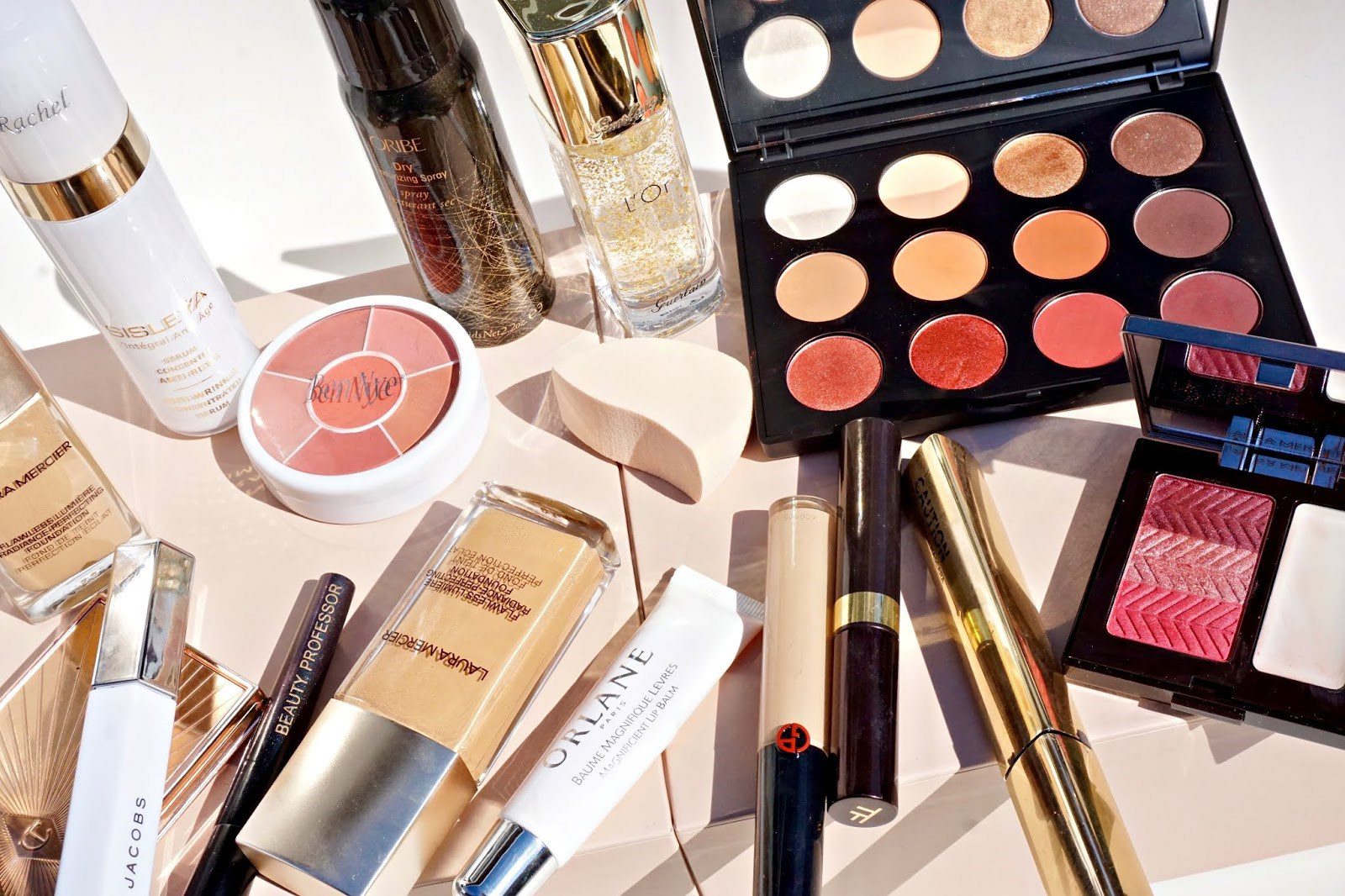
You pick up the Laura Mercier Flawless Lumiere tester in-store and it looks exactly right on your hand — radiant, even, like your skin but several degrees better. You buy the $48 bottle. Three weeks later it’s sitting in a drawer, used twice, because every time you wear it you look greasy by noon instead of glowing.
That outcome is predictable. And fixable.
What “Luminous Finish” Actually Means — and Why It Goes Wrong
Most product pages use “luminous,” “dewy,” and “radiant” interchangeably. They are not the same thing, and the difference matters before you spend $48–70 on a foundation bottle.
Luminous finish means light-reflecting particles — typically mica, pearl powder, or synthetic shimmer — are suspended in the formula. The glow comes from those particles bouncing light back at the viewer. It works regardless of your skin’s moisture level. The formula itself can feel lightweight or even dry to the touch.
Dewy finish is different. Dewy foundations have higher glycerin and water content. The sheen comes from moisture migration, not particles. On dry skin, this reads as real hydration. On oily skin, it amplifies existing sebum production and migrates off the face within two hours.
Satin finish is the middle ground — low sheen, no obvious shimmer, the most skin-type-agnostic of the three. If you’re unsure which finish suits your skin, satin is the lower-risk starting point.
Why Luminous Formulas Behave Differently by Skin Type
On dry and normal skin, luminous foundations deliver what they promise. The shimmer particles catch light on a calm, even canvas and read as genuine radiance. On oily skin, sebum production adds its own shine layer on top of the shimmer — the two effects compound, and the face reads as uncontrolled by mid-morning.
The inflection point is roughly three to four hours into wear. Dry skin gets better as the formula settles and warms. Oily skin gets worse as natural oils accumulate. If you’re blotting regularly on minimal-product days, a luminous formula carries real risk. That’s not a bias against luminous foundations — it’s a formula compatibility issue worth knowing before committing to a full bottle.
The Oxidation Problem Most Reviews Skip
Luminous foundations oxidize. All foundations do, but the lighter coverage of most luminous formulas makes the shade shift more visible. The Flawless Lumiere can shift one to two shades darker within 60–90 minutes as it reacts with skin’s pH and natural oils.
Testing on the back of your hand in Sephora tells you nothing useful about your face. Test on your jawline, walk out of the store, wait 45 minutes. Only then do you have real data. Results vary by skin type, individual chemistry, and environmental humidity — there’s no universal oxidation behavior across all wearers of this formula. Sample it; don’t guess.
How Undertone Affects the Shimmer Read
The Flawless Lumiere’s shimmer particles skew warm-gold. On neutral-to-warm undertones, that reads natural and enhancing. On cool-pink undertones, the same particles can introduce a subtle yellow cast that conflicts with the skin’s natural light reflection. Worth comparing on your actual face — not just the shade match, but the overall finish tone — before deciding this formula is the right one for you.
Skin Prep That Makes a Luminous Foundation Work
Foundation performance is roughly 60% prep and 40% the formula itself. A luminous foundation applied to poorly prepped skin shows every dry patch, concentrates shimmer in uneven areas, and wears poorly throughout the day. Here’s the prep sequence that changes the result.
- Cleanse with a non-stripping formula. Tight, dry skin after washing makes shimmer particles concentrate in dry patches and skip over areas of residual oil. A hydrating cleanser — CeraVe Hydrating Cleanser ($15) or La Roche-Posay Toleriane Hydrating Gentle ($18) — leaves skin ready without stripping it.
- Apply a humectant serum on slightly damp skin. Hyaluronic acid draws moisture into the surface and creates a smooth, hydrated base for the foundation. The Ordinary Hyaluronic Acid 2% + B5 ($9) handles this without adding texture or interfering with the formula above it.
- Follow with a moisturizer, not just a serum. Serums don’t provide enough occlusion on their own. A cream or lotion locks hydration in place. Wait 90 seconds for it to absorb before the next step.
- Avoid heavy silicone primers if possible. Silicone-based primers like Smashbox Photo Finish ($42) create a slip layer that luminous formulas can slide on, causing uneven shimmer distribution. If you need a primer on the T-zone, a water-based option — e.l.f. Poreless Putty Primer ($10) — creates far less interference with the formula above it.
- Wait two full minutes after skincare before applying foundation. Foundation applied over still-wet or tacky skincare absorbs unevenly. Shimmer particles concentrate in moist areas and skip others. Two minutes is the actual minimum, not an exaggeration.
The single most common prep mistake is too many skincare layers before foundation. A thin, well-chosen two-to-three-product base outperforms a saturated six-step stack every time. The formula needs to bond to skin, not sit on top of a wet surface.
In humid environments, lighter moisturizers work better under luminous formulas. Heavy cream moisturizers combined with ambient humidity can create excess moisture beneath the foundation, leading to earlier separation and formula migration throughout the day.
How to Apply Laura Mercier Flawless Lumiere Foundation
Which Tool Actually Gives the Best Finish?
A dense buffing brush produces the most controlled luminous result. The Real Techniques Expert Face Brush ($12) and the EcoTools Buffing Foundation Brush ($10) both perform well here. Use small circular motions from the center of the face outward, light pressure throughout. Coverage reads as medium, glow is present but controlled — not overwhelming.
A damp beauty sponge gives a more diffused, natural-looking result — the shimmer spreads more evenly and the finish reads slightly dewier. Better for dry skin, riskier for oily. Applying with fingers introduces too much heat variability and coverage inconsistency for all-over use; save that approach for spot touch-ups only.
How Do You Build Coverage Without Losing the Glow?
One thin layer first. Assess after 30 seconds. Add a second pass only in specific areas that need it — around the nose, any visible redness, concentrated discoloration. A full second layer applied everywhere cancels the luminous effect and pushes the formula toward heavy and cakey.
The under-eye area needs a separate concealer. The Flawless Lumiere’s shimmer emphasizes fine lines at close range — the opposite of what under-eye coverage should do. The NARS Radiant Creamy Concealer ($34) or Laura Mercier Secret Concealer ($32) both work here. Blend the edges into the surrounding foundation for a seamless transition rather than a visible line.
What’s the Right Way to Set It?
Heavy translucent powder applied all over immediately negates the finish. Full stop. Set only where shine is a genuine problem: the T-zone, sides of the nose, and chin. Use a small fan brush with restraint. The Laura Mercier Translucent Setting Powder in the Glow shade ($42) was formulated specifically to maintain radiance while reducing movement. Standard translucent powder works, but requires a significantly lighter hand and smaller quantities to avoid dulling the shimmer.
Flawless Lumiere vs. Competing Luminous Foundations
The comparison data, without the marketing language:
| Foundation | Price | Coverage | Shade Range | SPF | Best Skin Type |
|---|---|---|---|---|---|
| Laura Mercier Flawless Lumiere | $48 | Medium-buildable | 30 shades | SPF 18 | Dry to normal |
| Giorgio Armani Luminous Silk | $70 | Light-medium | 40 shades | None | All skin types |
| NARS Sheer Glow | $49 | Light-medium | 33 shades | None | Normal to dry |
| Fenty Beauty Eaze Drop | $36 | Sheer | 40 shades | None | All skin types |
| MAC Studio Radiance Face and Body | $42 | Sheer-medium | 25 shades | None | Normal skin |
The Armani Luminous Silk ($70) is the category benchmark — the shimmer is less obvious, the glow reads as more authentic skin. The Flawless Lumiere closes most of that gap at $22 less per bottle. The key differentiator for the Laura Mercier: it’s the only option on this list with SPF 18. For anyone who wants sun protection built into their base, that narrows the field significantly at the $48 price point.
For cool-toned skin specifically, the NARS Sheer Glow ($49) has more neutral shimmer particles and performs better across a wider undertone range than the Lumiere’s warm-gold formula. On a tighter budget, the Fenty Eaze Drop at $36 provides a lighter sheer finish with 40 shade options — more range than the Lumiere at a lower cost, if full coverage isn’t the goal.
Don’t buy any of these without sampling on your actual face first. Performance varies meaningfully by skin type and humidity level. Testing on your hand in-store is decorative, not diagnostic.
Completing the Look with MAC Art Library and Velour Lip Powder
A luminous base demands structure somewhere else on the face. That’s the design principle, not a style preference. Blurry, unfocused eye looks paired with a shimmer-heavy foundation make the entire face read as unresolved — everything competing for the same diffused glow with no anchor point to read as intentional.
The MAC Art Library palettes (ranging $55–65 depending on the edition) offer the variety needed to build that contrast. The Gems and Jewels edition and various seasonal releases include a reliable mix of matte, satin, and shimmer shades. Application principle: use the deepest matte shades for crease definition and outer corner depth. Matte formulas absorb light rather than reflect it, creating visual contrast against the luminous skin base. Any shimmer shades from the palette should stay on the lid center only — spreading shimmer into the crease adds to the total light-load on the face and diffuses the eye shape into indistinction.
Use a flat shader brush for shimmer placement and keep the edges precise. The matte crease transition shades can be blended broadly. The boundary between controlled shimmer and blended matte is what keeps a fully luminous look from reading as overdone.
The MAC Velour Lip Powder ($22) is a dry pigment with a soft-matte, velvet finish that applies differently from liquid matte or standard bullet lipstick. Use a lip brush for placement rather than applying straight from the applicator — the brush controls pigment density and prevents uneven edges. The formula won’t grip over oily or heavily balmed lips, so apply to clean lips with any balm fully absorbed first. Set the outer edges with a small amount of translucent powder to prevent feathering over the course of the day.
For color pairing against the Flawless Lumiere: warm neutral nudes and muted mauves in the Velour Lip Powder range read best. They let the luminous skin finish carry the look. Cool-pink lip shades will fight the warm-gold shimmer undertone in this foundation and create an undertone conflict across the face that reads as unbalanced. If you’re building a defined eye with the Art Library, bring the lip down to a neutral warm tone. If the eye is minimal, the lip can handle more pigment and color.
Who Should Skip This Combination
Oily skin, professional flash photography, and anyone in a warm humid environment for extended wear. The Flawless Lumiere will not hold past four hours under those conditions, and the shimmer particles photograph back as shine rather than glow under direct flash. For those scenarios, Fenty Pro Filt’r Soft Matte ($36) or Charlotte Tilbury Airbrush Flawless ($50) will deliver better results — and that’s a formula reality, not a personal preference.